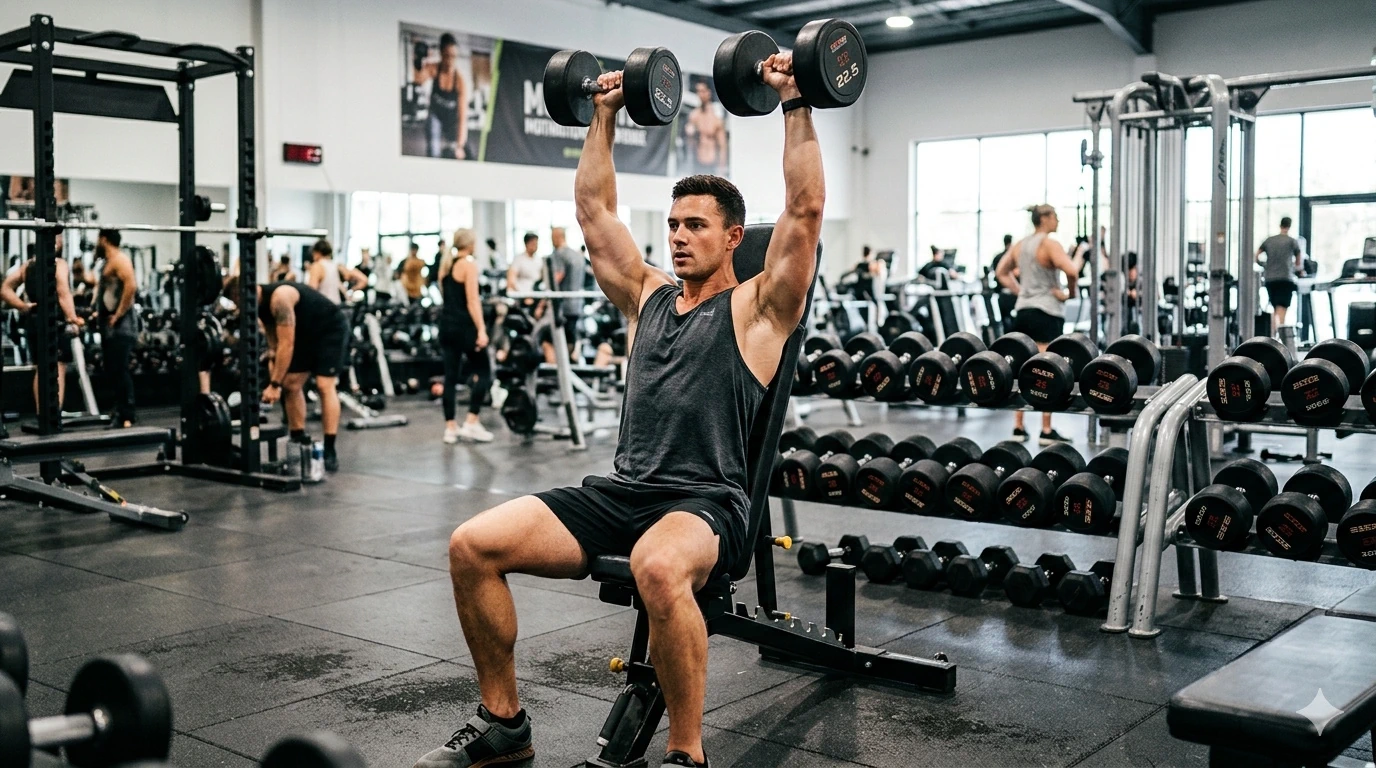
Short Answer
✅ Best for: Vertical pressing strength, shoulder hypertrophy, and overhead stability.
✅ Muscles targeted: Mostly anterior deltoid, with strong contribution from medial deltoid and triceps.
General Description
The Overhead Dumbbell Press is an excellent upper body vertical pressing compound movement.
It focuses on building strength and hypertrophy in the shoulders.
Unlike pressing movements that target the chest (like the Incline Dumbbell Press), this exercise emphasizes vertical pushing mechanics. This is why it recruits the deltoids and triceps in a way that translates well to functional strength.
Activation ratings are a simplified interpretation of EMG (electromyography) data and personal experience. EMG reflects muscle electrical activity, not direct hypertrophy or force production. Higher activation suggests greater involvement, but does not guarantee greater muscle growth.
| Muscle | Role | Activation |
|---|---|---|
| Anterior Deltoid | Primary Mover | Very High (⭐⭐⭐⭐⭐) |
| Medial Deltoid | Synergist | High (⭐⭐⭐½) |
| Triceps | Lockout / Secondary | Moderate to High (⭐⭐⭐½) |
| Upper Trapezius | Stabilizer | Moderate (⭐⭐⭐) |
Note: Triceps activation increases with heavier loads. The triceps contributes significantly to arm extension at the top of the overhead press.
What is the Correct Form and Technique?
Setup
- Position: Stand or sit with feet shoulder-width apart, keep your spine neutral.
- Dumbbell Start: Bring dumbbells to shoulder height with palms facing forward or slightly rotated.
- Elbow Position: Keep elbows slightly forward (not directly out to the sides) to protect the shoulder joint.
Execution
- Press Up: Drive the dumbbells upward in a straight line, fully extending the arms overhead.
- Lower with Control: Slowly lower the dumbbells back to shoulder height without losing tension.
- Breathing: Exhale as you press up; inhale on the way down.
Common Mistakes
- Excessive lumbar extension, also known as overarching. You need to brace your core and avoid turning the movement into an incline press.
- Allowing the elbows to flare too far outward.
- Using momentum rather than muscle control.
Programming for Hypertrophy and Strength
The overhead dumbbell press can be used for both muscle growth and strength development, depending on how it is programmed.
For Hypertrophy (Muscle Growth)
- Reps: 6-15 per set
- Sets: 3-5
- Rest: 1-3 minutes
- Load: Moderate weight, close to failure (0-3 reps in reserve)
Using dumbbells allows for a greater range of motion and individual arm control, which may improve muscle development and reduce imbalances between your left shoulder and your right shoulder.
For Strength
- Reps: 3-6 per set
- Sets: 3-6
- Rest: 2-4 minutes
- Load: Heavy weight with full control
If your goal is maximum strength development, barbell overhead pressing is typically superior because of higher loading potential. However, dumbbells remain very effective for building stable, balanced pressing strength.
To optimize results, combine this exercise with lateral raises and rear delt work. For more information, follow our evidence-based training principles explained in our complete muscle growth guide.
Differences between Overhead Dumbbell Press and Incline Dumbbell Press
Between the two exercises, the angle of movement and muscle emphasis are different. It is important to understand their differences so you can choose the best one depending on your goals: upper chest or shoulder development.
Comparison Table
| Aspect | Incline Dumbbell Press | Overhead Dumbbell Press |
|---|---|---|
| Primary Focus | Upper Chest, Anterior Deltoid | Anterior Deltoid, Medial Deltoid |
| Secondary Muscles | Triceps, Stabilizers | Triceps, Upper Trapezius, Rotator Cuff Stabilizers |
| Range of Motion | Good | Moderate to Good (depends on shoulder mobility) |
| Joint Angle | Horizontal-vertical hybrid (~30-45° incline) | Near-vertical (arms pressed slightly in front of the body) |
| Stabilizer Demand | Moderate | High |
| Functional Strength Transfer | Chest-dominant pushing (bench, pushups) | Overhead pushing (lifting objects overhead, pressing sports movements) |
To sum it up:
- The incline dumbbell press puts a bigger emphasis on the chest, while the shoulder press emphasizes the deltoids more.
- The incline dumbbell press is a horizontal-to-angled movement. The overhead press is purely vertical, which helps to improve overhead strength and shoulder stability.
- Triceps are involved in both, but tend to be slightly more activated in overhead presses. Shoulder press may engage more stabilizing muscles like upper traps and rotator cuff.
Strength Standards for Overhead Dumbbell Press
The standards shown are relative to bodyweight (BW).
You can have different results than what this table shows, depending on your experience, age, training intensity, frequency and volume.
This is the weight you can lift only one time (per dumbbell!), also called 1-rep max or 1RM.
Warning: these standards are only estimations! They are based on trends and my own experience. The standards are subjective, which also means they do not come from a scientific dataset or study.
The top ranges (World Class, and even Elite) represent exceptional levels and are rarely achieved, even with intense and consistent training for years.
- Beginner: 0-1 years of lifting.
- Intermediate: 1-3 years of consistent training.
- Advanced: 5+ years of dedicated training.
- Elite: Top 5% of gym-goers. Very high strength.
- World Class: Competitive strength athletes and/or genetic outliers.
| Experience Level | Men (% BW) | Men (kg, example 75 kg BW) | Women (% BW) | Women (kg, example 60 kg BW) |
|---|---|---|---|---|
| Beginner | 10-20% | 8-15 kg | 5-12% | 3-7 kg |
| Intermediate | 20-35% | 15-26 kg | 12-25% | 7-15 kg |
| Advanced | 35-50% | 26-38 kg | 25-40% | 15-24 kg |
| Elite | 50-70% | 38-53 kg | 40-60% | 24-36 kg |
| World Class | 70-90% | 53-68 kg | 60-80% | 36-48 kg |
If you want to see similar strength standards for lower body, check out our guide on the Barbell Back Squat.
If you like Science and Studies...
1 A study comparing different overhead press modalities found that dumbbell presses produce higher activation in the medial deltoid and lower trapezius compared with kettlebell versions. This may suggest strong recruitment of key shoulder stabilizers in dumbbell overhead presses. (check the study here).
2 Research examining shoulder press EMG activity showed high overall activation in the deltoids and upper back muscles across different loading conditions. This supports that the overhead press is an effective exercise for strengthening the shoulders. (check the study here).
3 Another study examined shoulder muscle activation across dumbbell press variations. The study found high anterior deltoid involvement, which suggests that overhead pressing is effective for targeting the front of the shoulder. (check the study here).
References
1 Busch A, Sarver X, Comstock K. Electromyographic analysis of shoulder-complex muscles performing overhead presses with dumbbell, kettlebell, and bottom-up kettlebell Journal of Bodywork & Movement Therapies. 2024;37:308-314. doi:10.1016/j.jbmt.2023.10.001.-
2 Błażkiewicz M, Hadamus A. The Effect of the Weight and Type of Equipment on Shoulder and Back Muscle Activity in Surface Electromyography during the Overhead Press - Preliminary Report Sensors (Basel). 2022;22(24):9762. doi:10.3390/s22249762.
3 Luczak J, Bosak A, Riemann BL. Shoulder Muscle Activation of Novice and Resistance Trained Women during Variations of Dumbbell Press Exercises Journal of Sports Medicine. 2013;2013:612650. doi:10.1155/2013/612650.