Short Answer
✅ Best for: Targeting the upper chest, also known as the clavicular head.
✅ The Best Incline Angle: A 30° incline is often preferable. Anything over 45° shifts emphasis toward the shoulders.
✅ Dumbbells vs. Barbell: The range of motion is often better for dumbbells, and dumbbells are also often friendlier on your shoulders.
General Description
The Incline Dumbbell Press is a very popular compound pressing exercise.
Most lifters do this exercise at the gym to grow the chest, but also to put a greater emphasis on the upper chest.
But is it really the case? Does it actually lead to more upper chest growth?
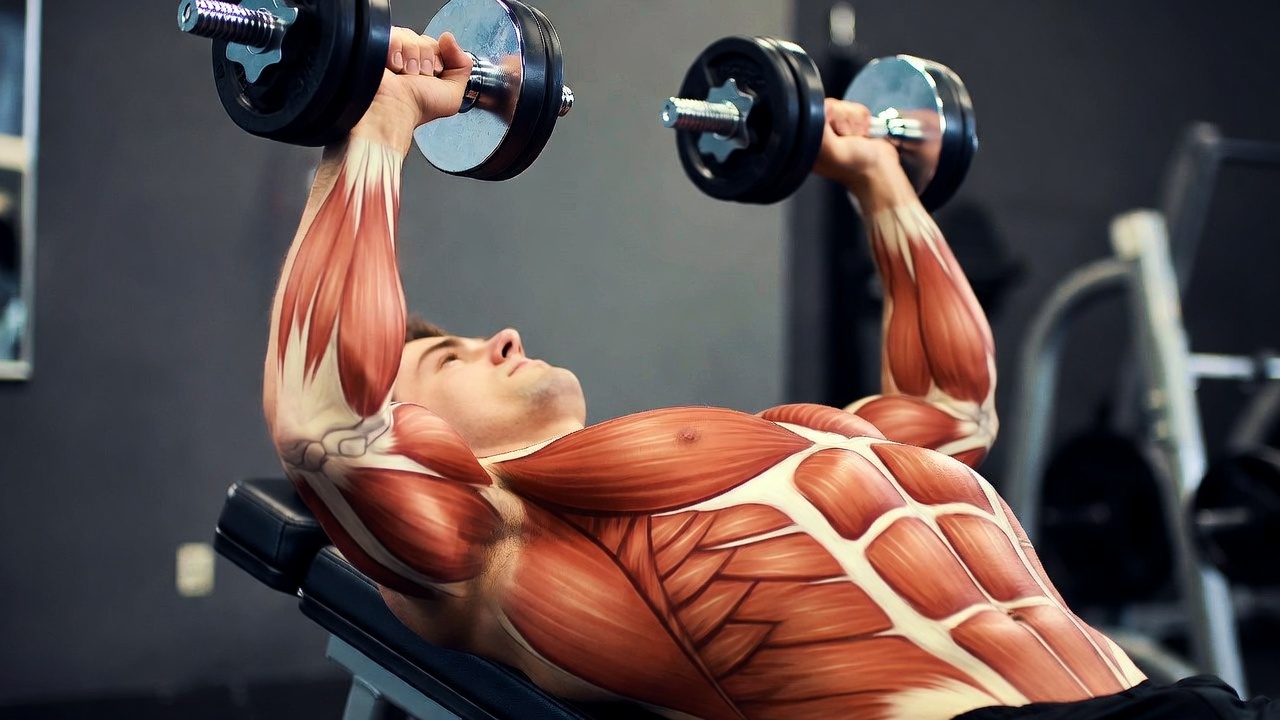
It targets the following muscles:
| Muscle | Role | Activation |
|---|---|---|
| Pectoralis Major - Clavicular Head (Upper Chest) | Primary Mover | Very High (⭐⭐⭐⭐⭐) |
| Pectoralis Major - Sternal Head (Lower/Mid Chest) | Primary Mover | High (⭐⭐⭐⭐) |
| Anterior Deltoid | Strong Contributor | High (⭐⭐⭐⭐) |
| Triceps | Secondary / Lockout | Moderate (⭐⭐⭐) |
What is the Correct Form and Technique?
Setup
- The Incline Angle: Set your bench to 30°, to bias upper chest without involving the shoulders too much.
- The "Kick": Sit down, rest the dumbbells on your knees, and use your thighs to "kick" the weights up to your shoulders.
- Warning: Be really cautious using that method, especially if you're a beginner and/or if you have poor coordination. You could injure yourself!
During the Movement
- Feet Flat: Plant your feet on the floor. This is important to have a lot of stability during the movement.
- 45° Elbows: Do not flare your elbows out wide like the letter "T". Tuck them in slightly (~30-60°) because a moderate elbow angle is often more shoulder-friendly. Indeed, this 'neutral' position prevents the upper arm bone from pinching the sensitive tendons in your shoulder. This painful condition that we want to avoid is known as subacromial impingement.
- The Deep Stretch: Lower the weights until your upper arms are level with your chest, or even slightly below (if you have enough shoulder mobility to do so).
- Control the lowering phase: Control the weights on the eccentric (lowering phase) of the movement.
- To feel it more in your chest: Do a slight pause at the bottom of the movement, where the tension is highest.
Differences between Flat Dumbbell Press and Incline Dumbbell Press
Both exercises are great for growing the chest. However, they emphasize slightly different muscles and they have different benefits.
Comparison Table
| Aspect | Incline Dumbbell Press | Flat Dumbbell Press | Flat Barbell Press |
|---|---|---|---|
| Upper Chest (Clavicular Head) | More | Less | Less |
| Mid/Lower Chest (Sternal Head) | Less | More | More |
| Anterior Deltoid | More | Less | Less |
| Triceps | Similar | Similar | Slightly More |
| Range of Motion | Good | Good | Moderate |
| Stabilizer Demand | More | More | Less |
Muscles targeted
1 EMG studies suggest that incline angles around 30° to 45° tend to activate the upper chest slightly more than a flat press. However, the difference is modest (around ~10-20%). Higher angles recruit the anterior deltoid more.
1 Very high angles (>45°) are less ideal, because they tend to shift activation away from the chest and toward the anterior deltoid. The exercise then resembles more like a shoulder-dominant pressing pattern, such as the Overhead Dumbbell Press.
1 The activation of the triceps muscle appears relatively constant for all incline angles, although some variation can happen depending on your technique.
It is also important to understand EMG studies (which measure muscle activation) don't translate directly into better muscle growth over time.
Range of motion
Incline dumbbell press often allows for a better range of motion than barbell variants.
Stabilizer Muscles
Compared to barbells, dumbbells require more effort in order to stabilize the weights. This increases the demand on the muscles that stabilize the elbow and shoulder joints. These muscles include the muscles of the rotator cuff and the scapular stabilizers.
Strength Standards for Incline Dumbbell Press
The standards shown are relative to bodyweight (BW).
You can have different results than what this table shows, depending on your experience, age, training intensity, frequency and volume.
This is the weight you can lift only one time (per dumbbell!), also called 1-rep max or 1RM.
Warning: these standards are only estimations! They are based on trends and my own experience. The standards are subjective, which also means they do not come from a scientific dataset or study.
The top ranges (World Class, and even Elite) represent exceptional levels and are rarely achieved, even with intense and consistent training for years.
- Beginner: 0-1 years of lifting.
- Intermediate: 1-3 years of consistent training.
- Advanced: 5+ years of dedicated training.
- Elite: Top 5% of gym-goers. Very high strength.
- World Class: Competitive strength athletes and/or genetic outliers.
| Experience Level | Men (% BW) | Men (kg, example 75 kg BW) | Women (% BW) | Women (kg, example 60 kg BW) |
|---|---|---|---|---|
| Beginner | 15-25% | 11-19 kg | 10-20% | 6-12 kg |
| Intermediate | 30-45% | 22-34 kg | 20-35% | 12-21 kg |
| Advanced | 50-65% | 38-49 kg | 40-55% | 24-33 kg |
| Elite | 70-90% | 53-68 kg | 60-75% | 36-45 kg |
| World Class | 95-110% | 71-83 kg | 80-90% | 48-54 kg |
If you want to see similar strength standards for lower body, check out our guide on the Barbell Back Squat.
If you like Science and Studies...
2 Glass & Armstrong (1997) compared EMG activity in the pectoralis major during incline and decline bench press. During the decline press, they found a greater lower chest (sternocostal head) activation. However, upper chest (clavicular head) activation did not change significantly between incline and decline. The results may suggest the decline press may not provide a significant upper chest advantage over incline. (check the study here).
3 Multiple studies have compared the effects in the long term between incline press and flat press. Unlike EMG studies, which only measure muscle activation during the exercise, the following study looked at long-term adaptations. This 8-week study was made on beginners, with two groups, one doing incline press and the other group doing flat press, both with the same volume. What the researchers found is that both groups gained similar strength levels (around 10kg in isometric bench press). However, the muscle thickness in the upper chest increased significantly more in the incline group compared to the flat bench press group. In untrained young men, incline presses led to slightly more upper chest growth over 8 weeks, while strength gains were similar. (check the study here).
References
1 Rodríguez-Ridao D, Antequera-Vique JA, Martín-Fuentes I, Muyor JM. Effect of Five Bench Inclinations on the Electromyographic Activity of the Pectoralis Major, Anterior Deltoid, and Triceps Brachii during the Bench Press Exercise. Int J Environ Res Public Health. 2020;17(19):7339. doi:10.3390/ijerph17197339
2 Glass SC, Armstrong T. Electromyographical Activity of the Pectoralis Muscle During Incline and Decline Bench Presses. J Strength Cond Res. 1997;11(3):163-167.
3 Martins-Costa HC, Freitas ED, Coelho DB, Franco FSC, Loenneke JP, Bottaro M, et al. Effects of Horizontal and Incline Bench Press on Neuromuscular Adaptations in Untrained Young Men. Int J Exerc Sci. 2020;13(6):859-872. doi:10.70252/FDNB1158【11†L216-L225】【11†L228-L232】.