Short Answer
✅ Squats target the quadriceps, glutes and adductors pretty well.
✅ Going deep recruits the glutes and adductors even more.
✅ Your core and spinal erectors work really hard to stabilize your torso.
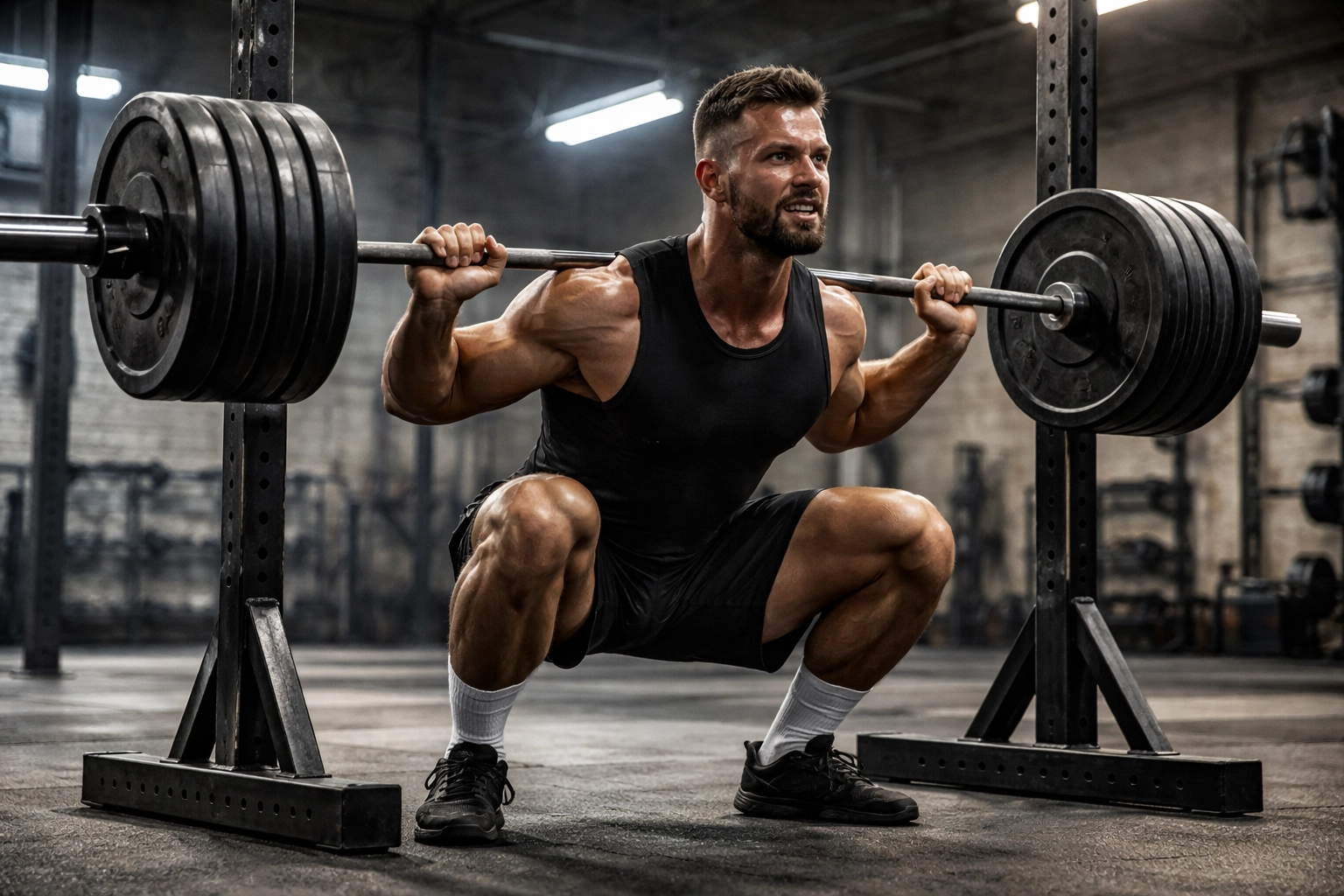
The Barbell Back Squat is often called the king of leg exercises, and there's a good reason for that. The squat does not only target the quadriceps very well, but also the glutes and the adductors, especially if you have a deep range of motion. For great legs development, the barbell back squat or a squat variation is very effective.
General Description
The Barbell Back Squat targets the following muscles:
| Muscle | Activation |
|---|---|
| Quadriceps (Front of the Thighs) | ⭐⭐⭐⭐⭐ (Very High) |
| Glutes | ⭐⭐⭐⭐ (High) |
| Adductors | ⭐⭐⭐⭐ (High) |
| Core (Abs & Obliques) | ⭐⭐⭐⭐ (Stabilization) |
| Spinal Erectors / Lower Back | ⭐⭐⭐ (Isometric Support) |
What is the Correct Form and Technique?
(For Barbell Back Squat)
Setup
- Choose a challenging weight, but not too heavy to avoid ego-lifting.
- Grip the bar around shoulder width.
- Put the barbell on your upper back (traps for high bar, rear delts for low bar)
- Unrack the bar and take a few steps back
- Your feet should be roughly shoulder-width apart, slightly turned out.
During the Movement
- Brace your core before squatting down.
- Break at the hips and knees at the same time.
- Go as deep as you can. Ideally, you should aim for below parallel.
- Avoid collapsing forward, and keep your chest proud.
Common Mistakes
- Knees caving inward
- Heels lifting off the ground
- Rounding the lower back
- Not going deep enough
- Using too much weight (ego lifting)
High Bar vs. Low Bar: Which is right for you?
Depending on where you place the bar on your back, some muscles may be more or less activated, and you can lift more or less absolute weight.
| Feature | High Bar Squat | Low Bar Squat |
|---|---|---|
| Bar Position | On the upper traps. | On the rear deltoids. |
| Torso Angle | More upright. | More forward lean (hip hinge). |
| Primary Focus | Quadriceps (more knee travel). | Glutes & Lower Back (more hip drive). |
| Max Weight | Usually lighter. | Usually allows for 5-10% more weight. |
The "Hamstring Myth"
Many people think that the Barbell Back Squat is an effective exercise for Hamstring hypertrophy. However, that's not really the case. In fact, electromyography (EMG) and muscle volume studies show low hamstring activation during the squat.
The Science: The hamstrings are bi-articular, which means they cross both the hip and the knee. During a squat, as the knee flexes (which would shorten the hamstrings), the hip simultaneously flexes (which stretches them back out). This means the hamstrings experience very little net length change, so they don't get the mechanical tension and stretch needed for meaningful hypertrophy. However, they still activate isometrically to help stabilize the knee, but this low-level activation is not enough for significant muscle growth.
If your goal is to grow the hamstrings, it is really recommended to supplement squats with movements like Leg Curls or Stiff-Leg Deadlifts.
Strength Standards for Barbell Back Squat
The standards shown are relative to bodyweight (BW).
Your results may vary based on experience, age, training intensity, frequency and volume.
This is the weight you can lift only one time, also called 1-rep max or 1RM.
Warning: these standards are only estimations! They are based on trends and my own experience. The standards are subjective, which also means they do not come from a scientific dataset or study.
The top ranges (World Class, and even Elite) represent exceptional levels and are rarely achieved, even with intense and consistent training for years.
- Beginner: 0-1 years of lifting.
- Intermediate: 1-3 years of consistent training.
- Advanced: 5+ years of dedicated training.
- Elite: Top 5% of gym-goers. Very high strength.
- World Class: Competitive strength athletes and/or genetic outliers.
| Experience Level | Men (% BW) | Men (kg, example 75 kg BW) | Women (% BW) | Women (kg, example 60 kg BW) |
|---|---|---|---|---|
| Beginner | 75-100% | 56-75 kg | 50-70% | 30-42 kg |
| Intermediate | 125-150% | 94-113 kg | 75-100% | 45-60 kg |
| Advanced | 175-200% | 131-150 kg | 110-140% | 66-84 kg |
| Elite | 225%+ | 169 kg+ | 150%+ | 90 kg+ |
If you want to see similar strength standards for upper body, check out our guide on the Incline Dumbbell Press.
If you like Science and Studies...
Squats are one of the most studied movements in exercise science. Most studies consistently show high activation of the quadriceps, glutes and adductors.
1 The deeper you squat, the more glutes and adductors are involved compared to partial squats. This can be explained due to increased hip flexion and stretch under load. (click here for the study) .
2 A study also found that using full range of motion for squats is better for hypertrophy compared to partial squats, even when using lighter weights. Generally, a full range of motion is superior or at least equal for hypertrophy. (click here for the study) .
3 Squats involve a ton of muscle mass, which creates a huge amount of systemic fatigue, making them really effective for strength development. (click here for the study) .
References
1 Caterisano A, Moss RF, Pellinger TK, et al. The Effect of Back Squat Depth on the EMG Activity of 4 Superficial Hip and Thigh Muscles. J Strength Cond Res. 2002;16(3):428-432. (View study)
2 Kubo K, Ikebukuro T, Yata H, Tsunoda N, Kanehisa H. Effects of Squat Training with Different Depths on Muscle and Tendon Adaptations. Eur J Appl Physiol. 2019;119(9):1933-1942. (View study)
3 Schoenfeld BJ. The Mechanisms of Muscle Hypertrophy and Their Application to Resistance Training. J Strength Cond Res. 2010;24(10):2857-2872. (View study)